
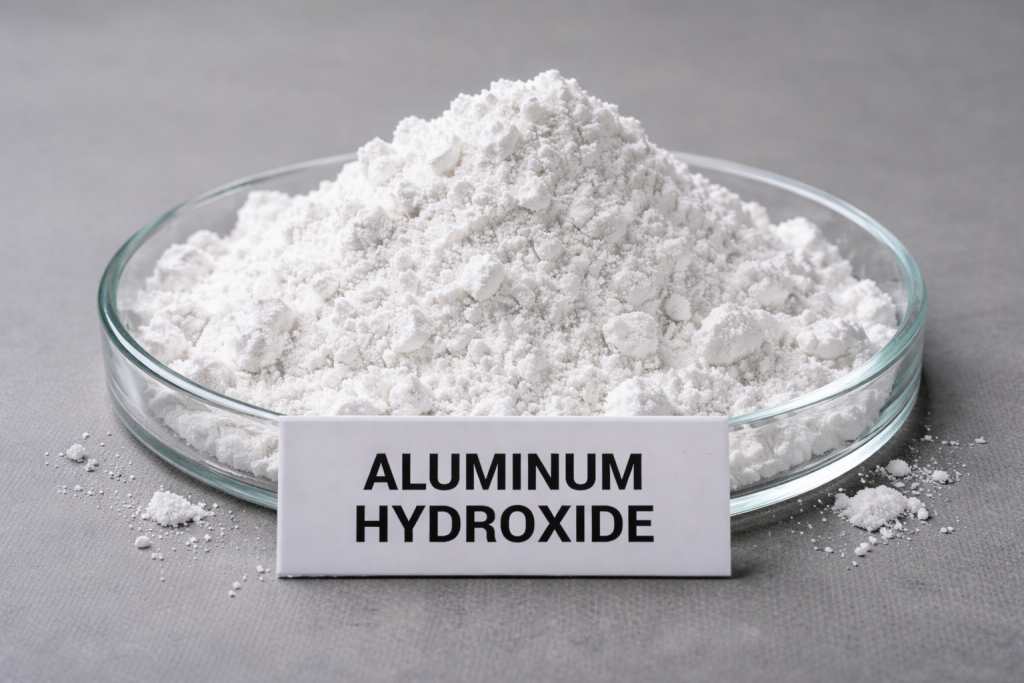
Aluminium Hydroxide (Al(OH)₃) is a white, odorless, and non-toxic chemical compound.
It is commonly known in industry as ATH (Alumina Trihydrate).
It is mainly derived from the mineral bauxite.
Appearance: White powder
Nature: Non-toxic and chemically stable
Solubility: Almost insoluble in water
Thermal Behavior: Releases water when heated
pH: Slightly basic
One of the most important uses of aluminium hydroxide is as a flame retardant filler.
When exposed to heat:
It releases water (H₂O)
Reduces temperature
Slows down fire spread
This makes it ideal for plastics, rubber, and cable applications
Plastics & Rubber Industry
Flame retardant filler
Smoke suppression
Paints & Coatings
Fire-resistant coatings
Improves surface finish
Paper Industry
Coating and filler material
Enhances brightness and smoothness
Water Treatment
Helps remove impurities
Pharmaceuticals
Used as an antacid (for acidity relief)
[
2Al(OH)₃ → Al₂O₃ + 3H₂O
]
Water release helps in fire control
Non-toxic and eco-friendly
Cost-effective
Excellent flame retardant
Reduces smoke generation
Decomposes above ~200°C
Requires high loading (40–60%) in materials
Aluminium Hydroxide is a widely used industrial chemical
Its main role is as a flame retardant and filler
Safe, economical, and versatile material
In an industrial context, polymer suppliers provide the raw polymer materials (like polyethylene, polypropylene, ABS, PVC, PET, etc.) that manufacturers use as the foundational input to make products. These suppliers often also offer additives, masterbatches, chemical compounds, and sometimes technical services.
Bauxite + NaOH → Sodium Aluminate Solution
Cooling + Seeding → Aluminium Hydroxide (Al(OH)₃) precipitates
Filtering & Drying → Final ATH product
Registered Address: Unit 1022A, Beverley Comm Centre, 87-105 Chatham RD Soth, Tsim Sha Tsui Hong Kong
China:+86 15136440046 , India : +91 8977609333
info@novaraglobalmining.com
2026 © Copyrights Novaraglobalmining